Backing the next generation of digital infrastructure talent — and what we heard in Austin.
Innovorg was a proud sponsor of the Talent in Digital Infrastructure track at Datacloud USA 2026 in Austin, September 1–3.
Most conversations in Austin were about capacity. Megawatts, gigawatt campuses, Blackwell deployments, build timelines measured in months instead of years. The track we backed was about the other side of that equation: the people who will have to run all of it.
What we heard
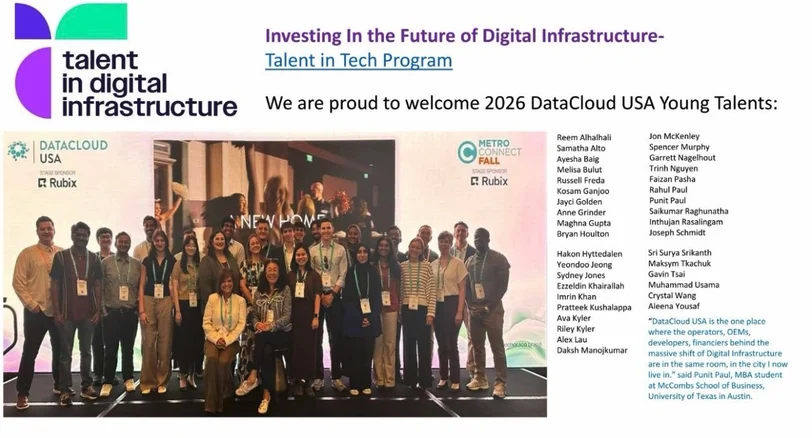
The Talent in Tech program brought students and early-career professionals into the event — economics graduates, MBAs, a chemical engineer, computational biologists, people from oil and gas and from software. One statement kept showing up, in different words:
I don't come from a traditional data center background.
I don't know where I fit.
That statement is the talent problem in this industry, stated from the inside. The industry is growing faster than the workforce that operates it, and the people trying to get in don't know whether there is a door for them.
The wrong background
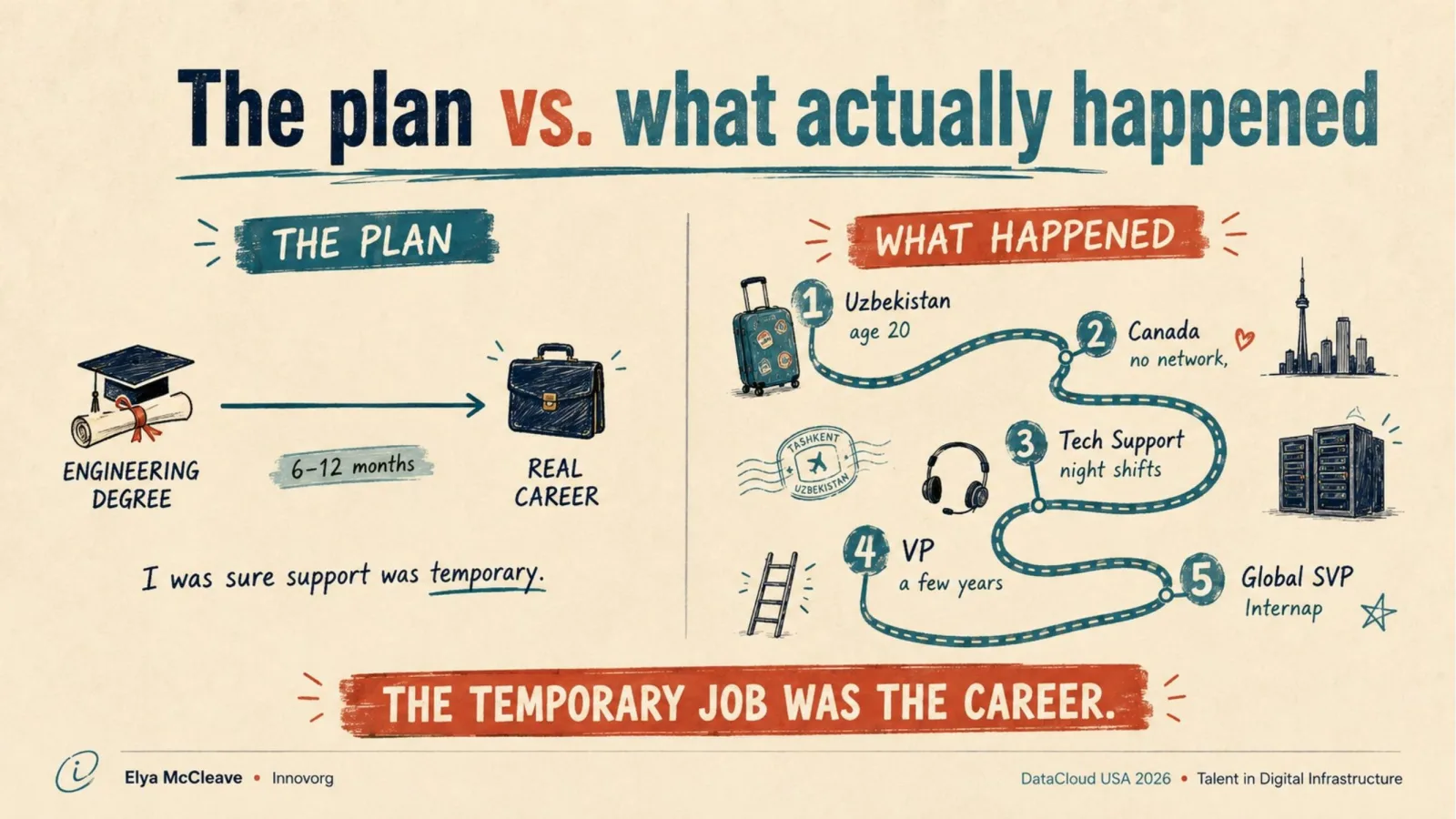
Our founder Elya McCleave's talk to the program was called "The Wrong Background," because twenty years ago that sentence was hers. She landed in Canada from Uzbekistan at twenty, with no network and English as a second language, and took a night-shift tech support job at one of the first data center and hosting companies — a job she was sure was temporary. It became a career that ran through supervisor, director, VP and Global SVP of Services, leading teams across continents.
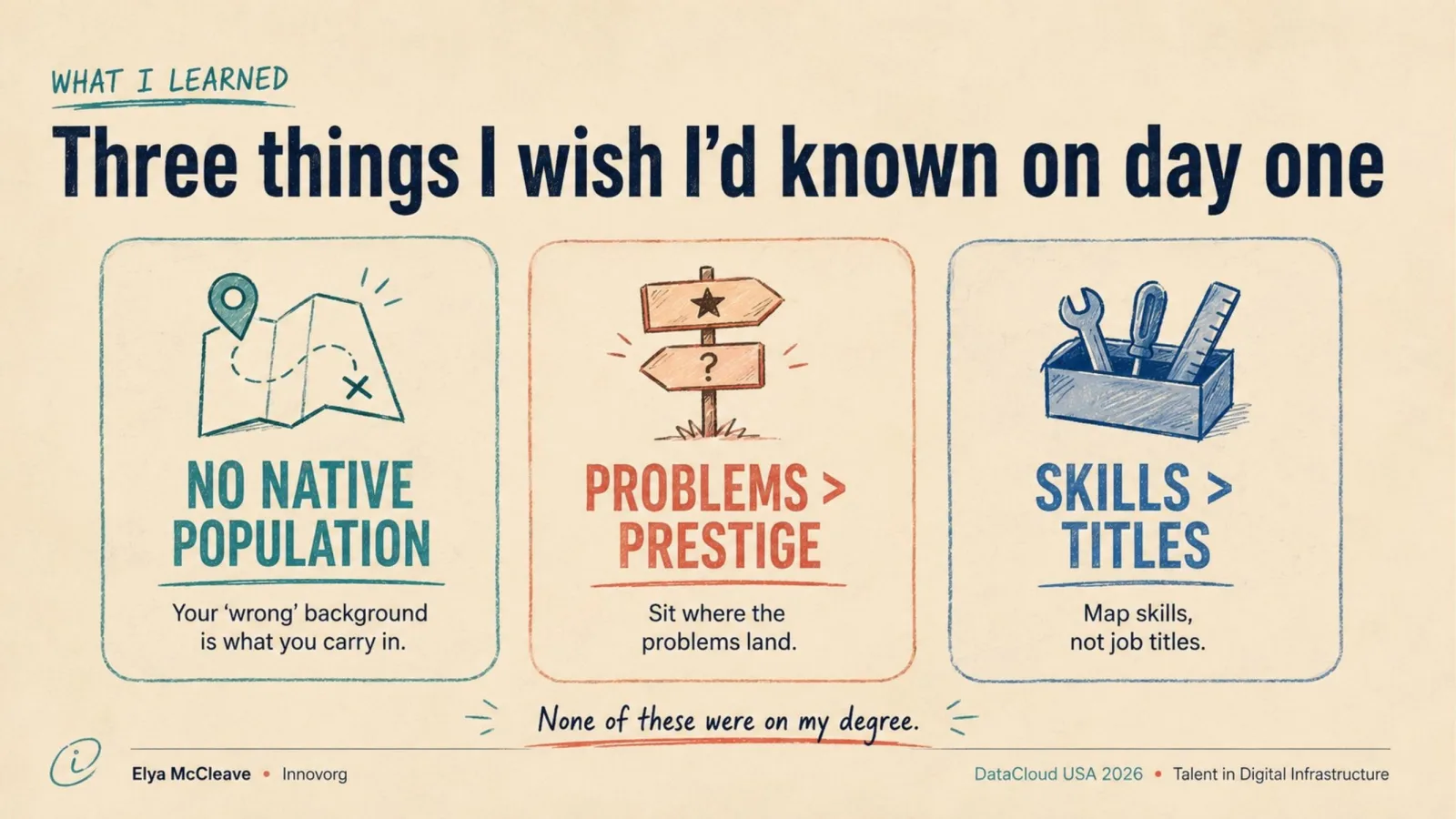
Three things from that talk that the whole industry should hear:
There is no native population. No one grew up in data centers. Everyone arrived from somewhere else, which means the "wrong" background is the standard entry condition. What people carry in from other fields is scarce here. Rare beats familiar.
Proximity to problems beats prestige. Support, operations, delivery and sales are where the industry actually teaches itself. That's where people learn fastest and get noticed fastest.
Careers here are built on skills and trust, not titles. Nobody asked about a degree again. Not once in twenty years. The question that matters is "what did you have to get good at to get here?" — because that answer transfers and titles don't.
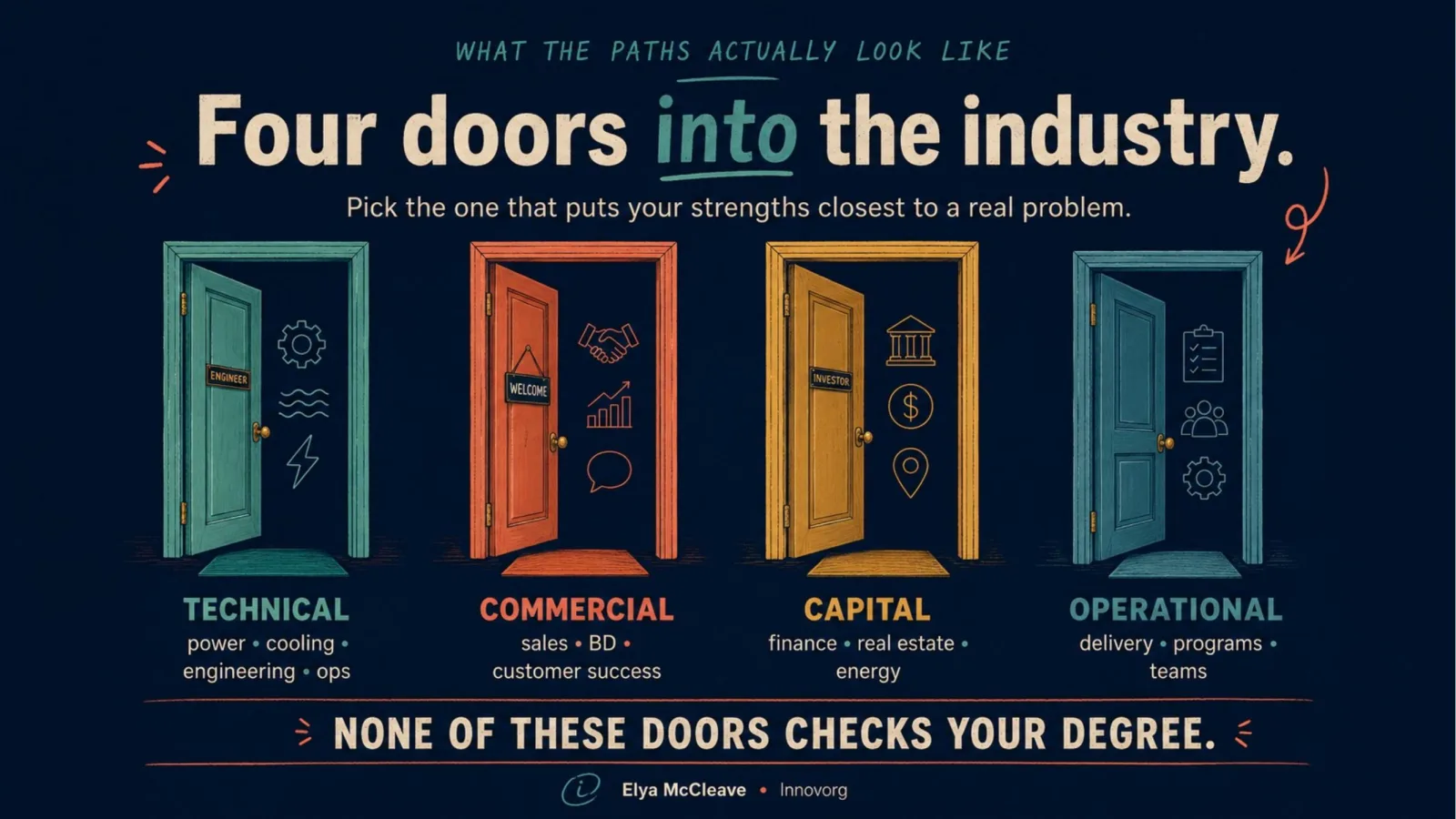
And four doors into the industry, none of which checks your degree: technical, commercial, capital, and operational.
The room
Elya joined a few amazing speakers — Swati Mehra (Cloud Operations + Innovation, Microsoft), RoseAnne Franco (Global Sustainability Leadership Institute, UT Austin McCombs) and Annabel Helm (Managing Director, Datacloud) — on a panel moderated by Susanna Kass, Chair of Talent in Digital Infrastructure.
Looking at the cohort was a reminder of her own start in this sector, a long time ago. The best part came afterwards: the students and young professionals who came up, said hello, asked questions, and kept talking. That was the highlight of the week.
Susanna was remarkable — commanding the room, moving it along, making space for every speaker. And she said the thing that stayed with us:
Giving back is not only about money. It is time, and it is passion. That is the harder thing to give.
It is also what this industry actually needs.
Why this is our mission
Innovorg exists because the way this industry hires and develops people hasn't kept pace with how fast it builds. Operators are still filtering by title, degree and "data center experience" — a filter that would have screened out most of the people who now run the room.
If there is no native population, then the talent pool is everyone who can become capable of what the job actually requires. The only way to see that is to measure capability directly: what people know, what they can do, what they've done, and what that adds up to. That is the work we do with operators every day, and it is why we chose to put our name on the talent track rather than anywhere else at the event.
Capacity gets built. Capability has to be grown, measured and trusted. We sponsored Talent in Digital Infrastructure because the next generation is already here, in the room, with the wrong background — and this industry needs every one of them.
Thank you to Susanna and the entire team at Datacloud, a Techoraco brand, for a fantastic event; to the Talent in Tech volunteer program for the platform; and to Isabelle Vleminckx and Louise Burrett, who made our involvement possible at the last moment. Innovorg was proud to sponsor alongside Vertiv and EdgeConneX.