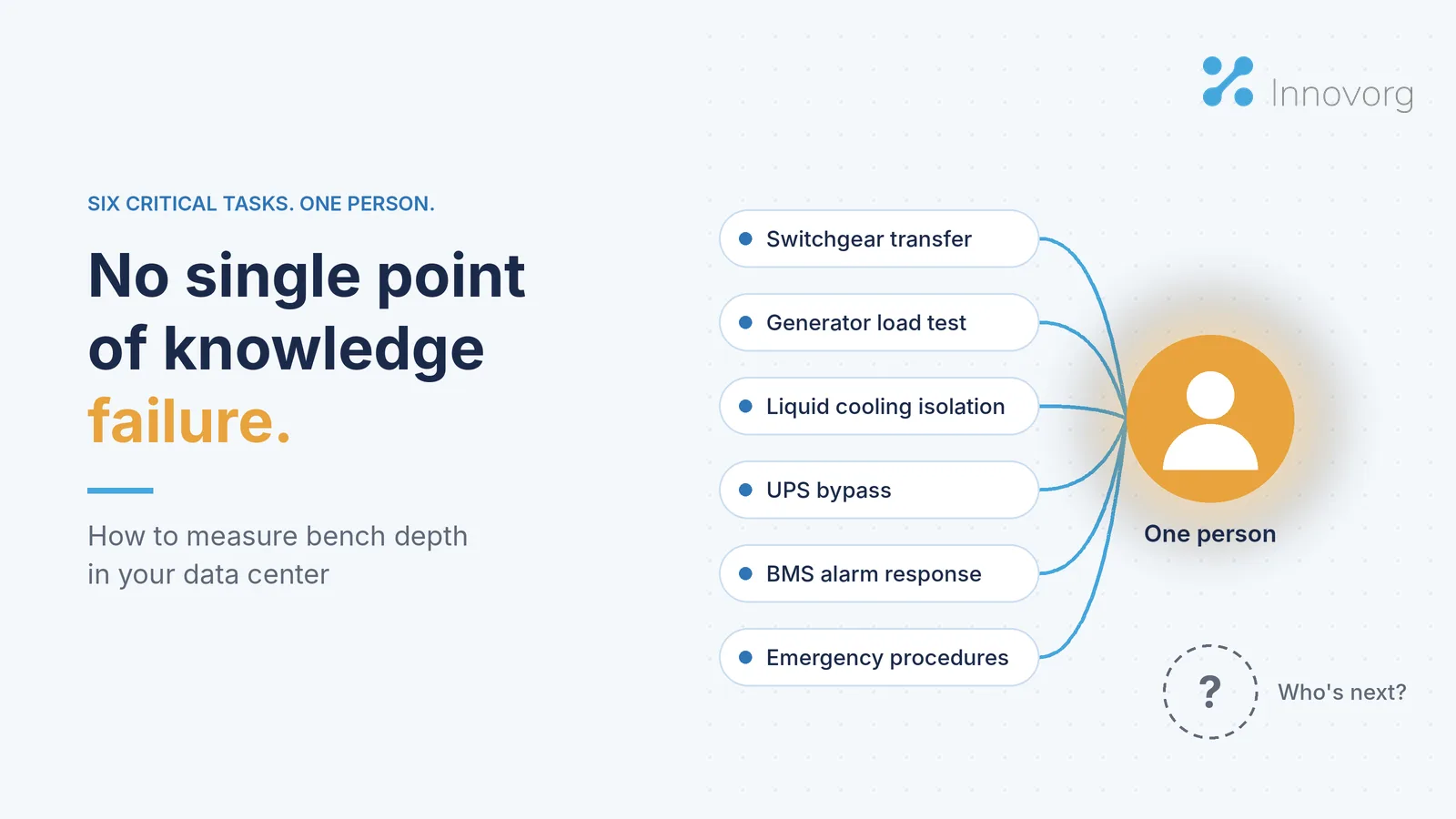
No operator would run a critical power or cooling system without redundancy. Yet many sites run critical procedures on one person's knowledge. Here is how to find those single points of failure, measure your bench depth by role and site, and build the same redundancy into your team that you build into your plant.
The question every supply chain team already asks
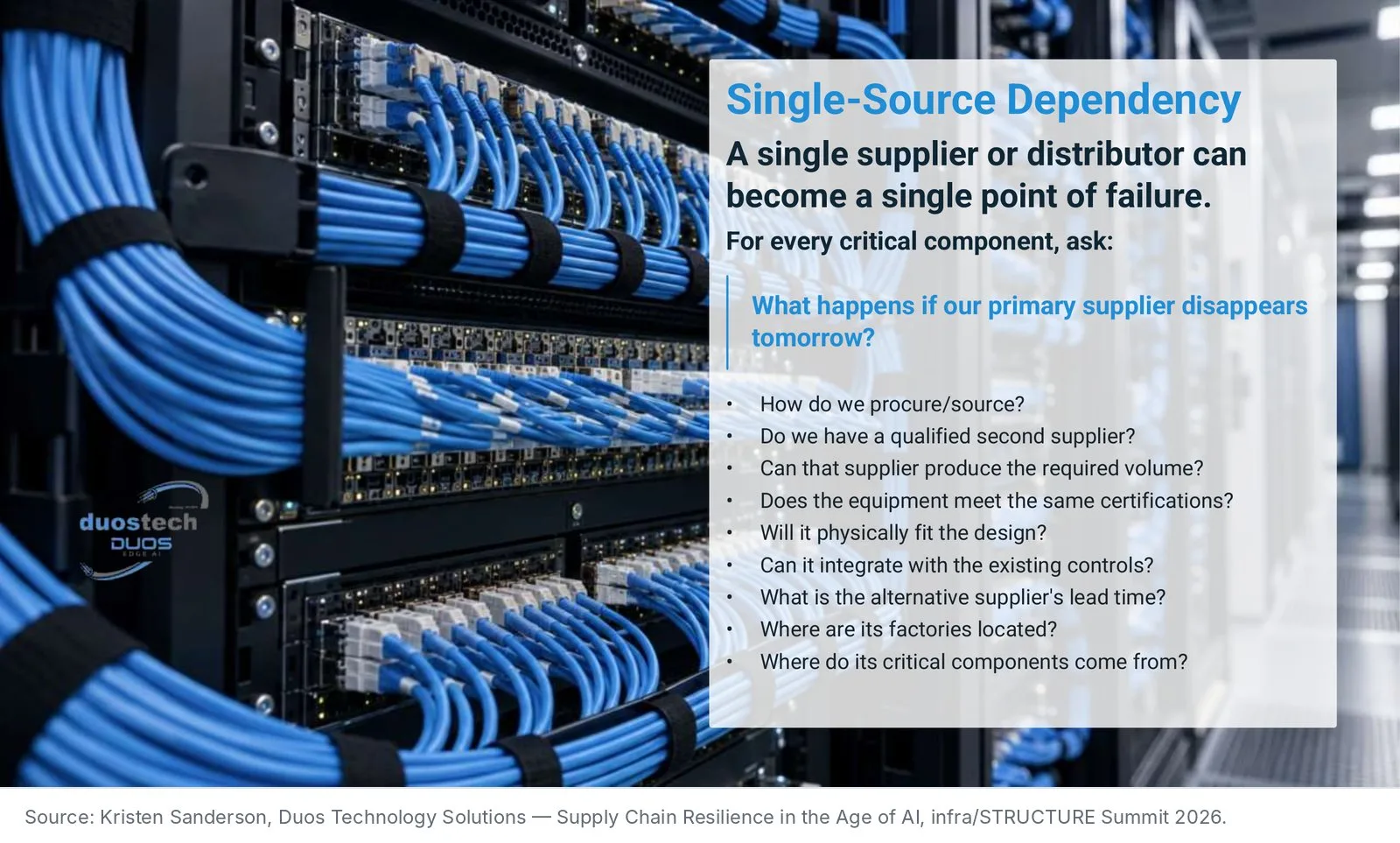
At infra/STRUCTURE 2026 in Las Vegas, Kristen Sanderson, SVP at Duos Technology Solutions, walked through supply chain resilience in the age of AI. Her test for every critical component was simple:
What happens if our primary supplier disappears tomorrow?
Then came the follow-ups. Do we have a qualified second supplier? Does their equipment meet the same certifications? Can it integrate with what we already run? What is their lead time?
It is the right discipline. Operators qualify second suppliers, hold spares and design for multiple equipment platforms, because the cost of being unable to deploy or recover is far higher than the cost of resilience.
Now swap the word component for person:
- Is there a qualified second person for every critical procedure?
- Do they hold the same certifications?
- Are they proven on the same equipment, at the same site?
- If they are not ready today, how long until they are?
Most operators have a process for the first list. Very few can answer the second at all.
Where single points of knowledge failure hide
A single point of knowledge failure is any critical task, procedure or decision that only one person at a site is proven ready to perform. Lose that person, to a resignation, a promotion, a new site or a two-week vacation, and the capability leaves with them.
They rarely look like risk. They look like your best people:
- The engineer who knows the switchgear sequence. Every transfer runs through them because they have done it a hundred times.
- The one technician certified on the new liquid cooling loop. The vendor trained one person at commissioning, and nobody since.
- The shift lead every escalation runs through. The procedures exist, but the judgement lives in one head.
- The controls specialist who built the BMS logic. The documentation is three revisions behind what is actually running.
- The commissioning lead who knows why the site was built the way it was. That context rarely survives handover to operations.
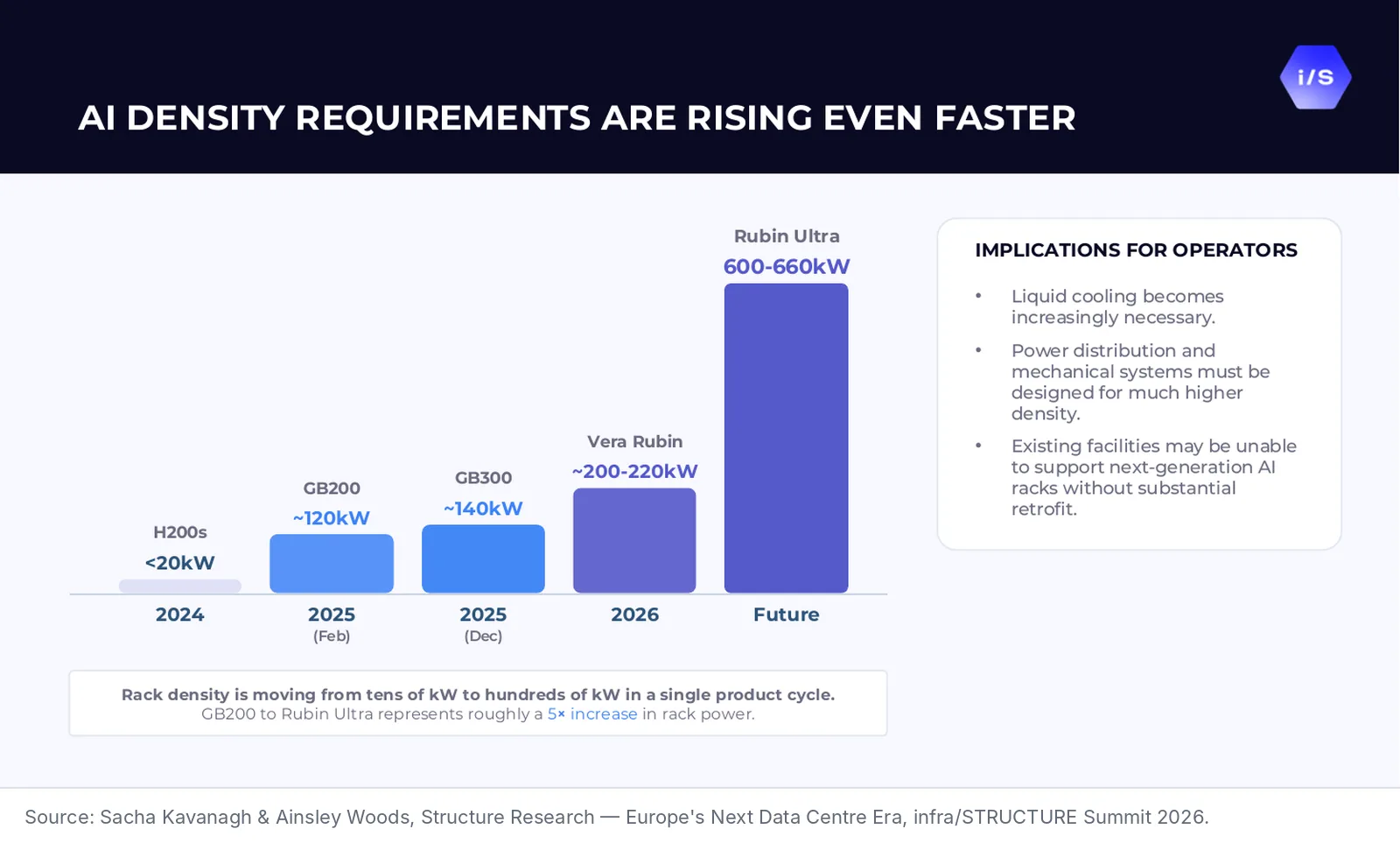
AI-era build-outs make this worse, not better. Rack densities are rising, liquid cooling is moving from pilot to standard, and new sites are opening faster than experienced teams can be grown. Every new technology arrives with a handful of people who understand it, and the bench behind them is thin.
And the stakes are not theoretical. When a critical procedure depends on one person, an incident at 3 a.m. becomes a phone call and a wait. A planned maintenance window slips because the only qualified person is at another site. A customer audit asks who is certified, and the answer is a name, not a team.
Why they stay invisible
If single points of knowledge failure are this costly, why do so few operators track them? Three reasons.
1. Risk registers track equipment, not people. Site risk reviews cover N+1 on generators, UPS and chillers in detail. The people who operate and recover those systems rarely appear on the register at all.
2. Every system holds one piece of the answer. Your HRIS knows the roles. Your LMS knows the courses. Your certification tracker knows who passed what. Your BI dashboards know the KPIs. None of them can tell you how many people at a given site are proven ready for a given critical task, because each defines "ready" differently, or not at all.
3. Certified is not the same as ready. A certificate proves someone passed an assessment, once. It does not prove they have performed the procedure on this equipment, at this site, recently. A site can show five certified people on paper and still have only one who can do the work under pressure.
The result is that bench depth gets discovered, not measured. It surfaces during an incident, a resignation or an audit, which is the most expensive moment to find it.
How to map bench depth, role by role and site by site
Bench depth is the number of people at a site who are proven ready to perform a critical task without supervision. You can map it in five steps, with a spreadsheet to start.
- List the critical work, not the job titles. For each site, write down the procedures that would stop or endanger operations if nobody could perform them. Think switchgear transfers, generator load tests, liquid cooling loop isolation, BMS alarm response and emergency operating procedures. Job titles hide the risk; tasks reveal it.
- Set the level each task requires. Decide what proficiency someone needs to perform it unsupervised. On our five-band scale (Awareness, Assisted, Independent, Advanced, Expert), that is usually Independent or above, and Advanced for the highest-risk procedures.
- Count who is proven at that level. Count people per task, per site, who meet the required level with evidence, not just a self-rating. Evidence means a manager's validation, observed performance or a lab, and a current certification where one applies.
- Plot it as a grid. Put critical tasks down the side and sites across the top. Each cell holds the bench depth. Every 0 is a capability gap. Every 1 is a single point of knowledge failure.
- Add time. For each bench of one, name the next-closest person and estimate how long they need to close the gap. Then flag certifications that expire in the next 90 days, because today's bench of two can be next quarter's bench of one.
Here is what the grid looks like in practice:
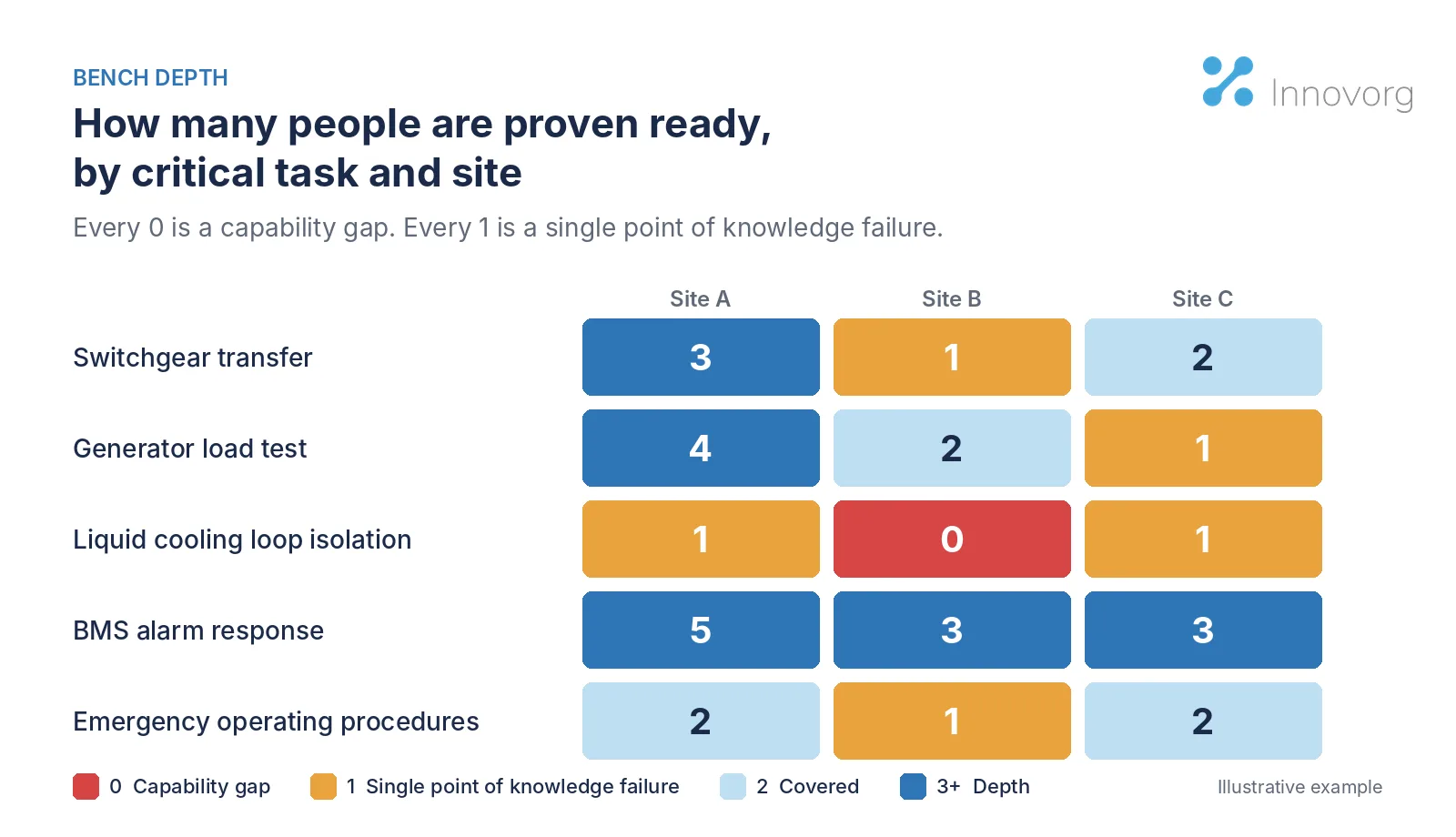
The first time a team builds this grid, the pattern is usually the same. Mature systems have reasonable depth. The newest technology, here liquid cooling, is thin everywhere. And one site carries most of the risk.
Build redundancy into the team, then close the gaps
Once you can see bench depth, you can set a target for it, the same way you set redundancy targets for infrastructure.
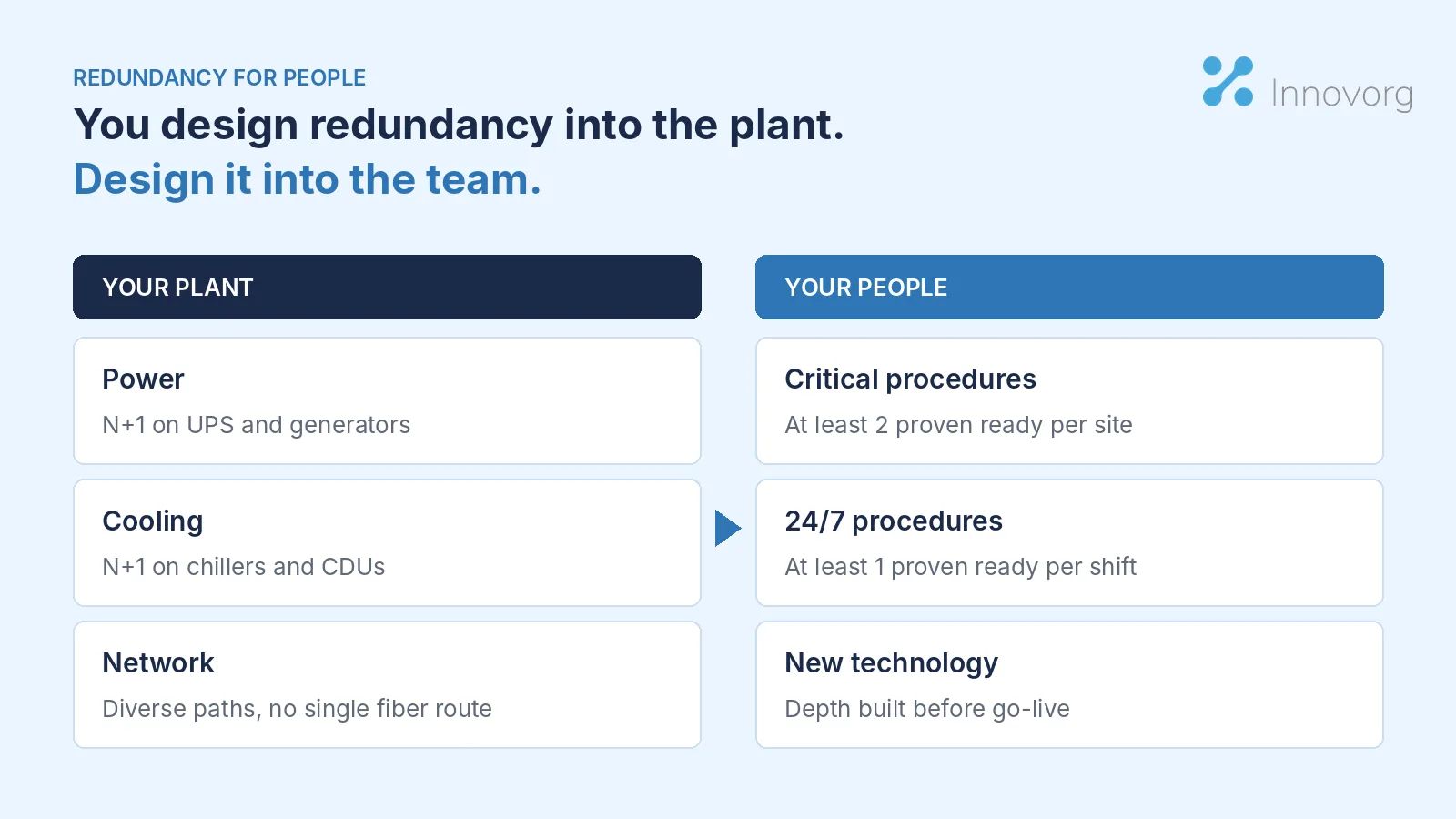
- N+1 as the floor. The same logic you apply to UPS and generators: every critical task at every site needs at least two people proven ready. One to do the work and one to cover.
- Shift-aware depth for 24/7 procedures. If a procedure can be needed at any hour, one qualified person per shift is the real minimum, not two across the whole site.
- Higher depth for the newest technology. Where equipment is new to the site, build depth before go-live, not after the first incident.
Closing the gap is then a planning problem, not a scramble:
- Pair before you promote. Put the next-closest person alongside the expert on every planned execution of the procedure, and record it as evidence.
- Sequence certifications against the gaps. Spend the training budget on the cells that are 0 or 1, not on whoever asks first.
- Capture the knowledge, then prove it transferred. Documentation helps, but a procedure is only covered when a second person has demonstrated it.
- Plan for moves before they happen. A promotion, a transfer to a new build or a retirement should trigger a bench check before the announcement, not after.
- Make depth part of career growth. Experts who build a bench behind them are the people you want leading the next site. Recognise it.
The point is not to make anyone replaceable. It is to make sure the site never depends on one person being reachable in the middle of the night.
How we measure bench depth at Innovorg
A spreadsheet gets you a first picture. Keeping it true is the hard part, because people move, certifications expire and new equipment arrives every quarter.
That is why Innovorg puts everything on one standard. Sites and org units, roles and responsibilities, skills and sub-skills, objectives and KPIs, tasks, learning, certifications and career development all connect to the same calibrated proficiency bands. Readiness is scored from six signals, and half of the score comes from demonstrated competency, not self-assessment.
Because every part of the standard is connected, bench depth is not a report someone builds before an audit. It is a live view. You can see, for every critical task at every site, how many people are proven ready, where the benches of one are, and who is closest to closing each gap.
Seeing the gap is only half the job. Because the same standard drives Adaptive Learning, Certification Management and Career Development, closing it happens in the same place. Training plans target the 0s and 1s first, expiring certifications are flagged before they thin the bench, and career paths recognise the experts who build depth behind them.
Same score, same meaning, at every site.
Ready to see it on your workforce? We will map bench depth for one of your sites and show you where your single points of knowledge failure are. Book a demo →